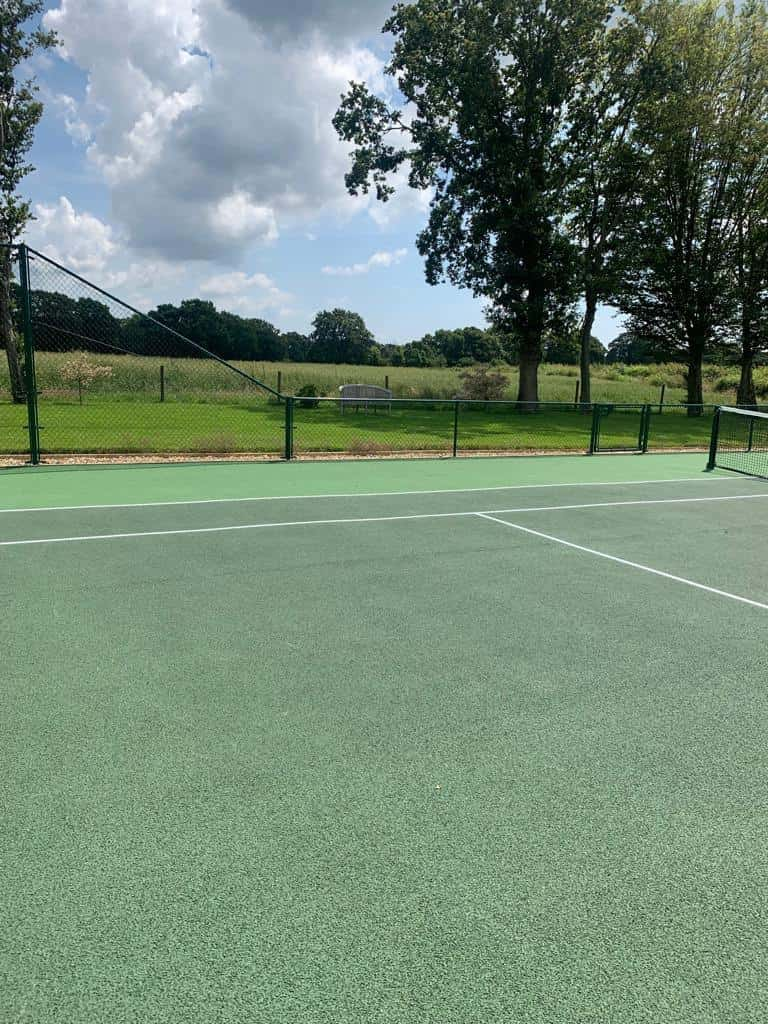
Tennis courts are exposed to regular play, changing weather conditions and natural ground movement. Over time, cracks, worn coatings, faded markings and drainage problems may begin to affect their appearance and playing performance.
Although tennis court repair and resurfacing are closely related, they are not the same service. Repair targets particular defects, while resurfacing renews the broader playing surface. Understanding the difference helps court owners choose work that addresses the actual condition of the court rather than simply covering visible symptoms.
For tennis courts in Kent, UK, the correct solution depends on the extent of the deterioration, the stability of the base and the standard of finish required.
Choosing Between Tennis Court Repair and Resurfacing
What Does Tennis Court Repair Involve?
Tennis court repair focuses on specific areas of damage. The aim is to restore the integrity and usability of the affected section while retaining as much of the existing surface as possible.
Typical repair work may address:
- Localised cracks
- Small areas of surface deterioration
- Minor depressions or uneven sections
- Loose or fretting material
- Damaged edges and joints
- Isolated drainage-related defects
The correct repair method depends on why the damage developed. Filling a crack without investigating movement beneath it may provide only a temporary improvement. Professional repair therefore begins with identifying whether the defect is limited to the surface or connected to the underlying construction.
When Is a Localised Repair Suitable?
Repair may be appropriate when most of the court remains stable and serviceable. A small number of isolated cracks or damaged areas can often be treated without resurfacing the whole playing area.
This approach is particularly suitable when the surface still provides consistent grip, colour and ball response across the majority of the court. It allows individual weaknesses to be corrected before water penetration and repeated use cause them to spread.
However, local repairs can become less effective when deterioration appears across numerous areas. Continually patching an extensively worn court may create an inconsistent playing surface without addressing its overall decline.
What Does Tennis Court Resurfacing Involve?
Resurfacing is a more comprehensive process designed to renew the playing layer across the court. The existing surface is assessed and prepared before appropriate coatings or surfacing materials are applied.
Depending on the court’s construction and condition, preparation may include cleaning, treating cracks, correcting minor irregularities and removing loose material. The renewed surface is then finished to provide a consistent texture, appearance and playing response. Court markings can also be reinstated as part of the process.
Resurfacing improves much more than colour. When properly completed, it can restore grip, create a more uniform ball bounce and make the court easier to maintain.
When Does a Court Need Resurfacing?
Resurfacing may be the better option when wear is widespread rather than confined to one or two areas. Common indicators include:
- Extensive fading or discolouration
- Multiple surface cracks
- Worn or difficult-to-see line markings
- Inconsistent grip across the playing area
- Widespread fretting or surface breakdown
- Numerous previous patches
- Uneven playing characteristics
A court does not need to be unusable before resurfacing is considered. Renewing a stable but tired surface can prevent general wear from developing into more extensive deterioration.
Resurfacing Cannot Correct Every Structural Problem
A new playing layer relies on a sound and stable base. If the court has major movement, widespread subsidence or substantial drainage problems, resurfacing alone may not provide a lasting solution.
Applying new material over an unstable foundation can allow cracks and uneven areas to return. These underlying defects need to be identified and addressed before the surface is renewed. In some cases, more extensive reconstruction may be required to restore dependable performance.
This is why a detailed inspection is essential. It distinguishes cosmetic wear from structural failure and prevents unsuitable work from being carried out.
How Repairs and Resurfacing Can Work Together
Repair and resurfacing are not always separate choices. Repairs are frequently an important part of preparing a court for resurfacing.
Cracks, depressions and damaged sections should be treated before the new playing layer is applied. This creates a more consistent foundation and helps the resurfaced court perform as intended. Completing both elements as one planned project can also produce a cleaner and more uniform result than a series of unrelated patches.
What Should a Professional Court Assessment Cover?
A professional assessment should consider the complete court rather than its colour or visible cracks alone. Important areas include:
- The type and extent of surface damage
- The stability and level of the playing area
- The condition of previous repairs
- Drainage and water retention
- Surface grip and ball response
- Edges, joints and surrounding access
- The condition of coatings and line markings
These findings help establish whether targeted repair, full resurfacing or more substantial remedial work is the most appropriate response.
Why the Correct Treatment Matters
Choosing the correct treatment helps preserve consistent playing characteristics and prevents minor defects from being concealed beneath a new finish. Local repairs can extend the serviceable life of a court that remains generally sound, while resurfacing can restore a tired playing area when deterioration has become widespread.
The quality of preparation is central to both services. Clean surfaces, compatible materials and carefully completed repairs all contribute to a more reliable result.
Conclusion
Tennis court repair addresses individual defects, whereas resurfacing renews the wider playing surface. Repairs are often suitable for isolated cracks and damaged sections, while resurfacing is more appropriate when wear, fading and inconsistent performance affect much of the court.
Neither option should be selected on appearance alone. The base, drainage, surface condition and history of previous repairs must all be considered. If your court in Kent, UK, is showing signs of deterioration, contact Tennis Court Construction Kent to arrange a professional assessment and receive clear guidance on the most suitable treatment.
Call us on: 01580 234 693
Click here to find out more about Tennis Court Construction Kent
Click here to complete our contact form and see how we can help with your court needs.